

Some creative projects need more than a beautiful image. They need history, texture, and personality. Vintage-inspired decoupage paper can turn a plain box into a keepsake, refresh tired furniture, or start a layered mixed-media composition.
Milton’s Daughter offers papers designed for this work. Botanical studies, birds, nautical scenes, seasonal illustrations, and old-world ephemera help a project feel collected rather than newly manufactured.
Vintage Style Without Searching for Fragile Originals
Authentic letters, postcards, book pages, and illustrations have undeniable appeal, but old paper can be delicate, scarce, or unsuitable for cutting and gluing. A vintage-inspired reproduction gives a maker the look of aged material without requiring an original document to be altered.
This approach belongs to a broader decorative tradition. Museum collections show how decorated-paper techniques, including decoupage, stenciling, marbling, and illumination, enriched books and works on paper. Today’s artists can adapt that spirit to a personal palette, surface, and story.
The artwork’s aged appearance can soften a freshly painted background and add instant visual depth. Faded typography may create the feeling of a found letter. Botanical plates can suggest an old naturalist’s notebook. Birds, florals, and maritime images can set a clear theme without making the finished piece feel overly coordinated.
Designs That Support Different Creative Directions
The Monahan Papers collection at Milton’s Daughter includes 24 lb. decoupage sheets with many vintage-style subjects. Product pages commonly identify an 11-by-17-inch format, suited to a full composition or smaller details.
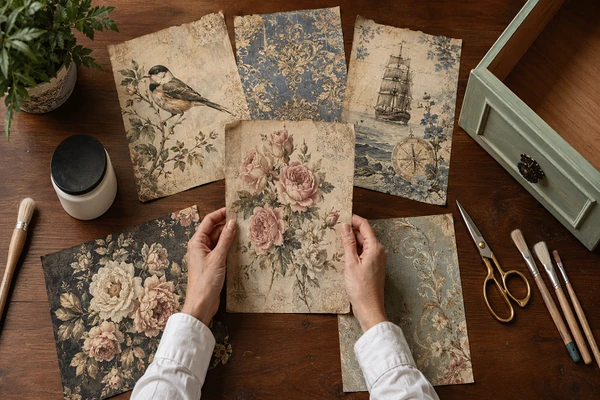
That variety supports several styles. A single large image can become the focal point on a cabinet door, tray, framed panel, or wood canvas. Smaller motifs can be cut or torn from the sheet and arranged around painted areas, moulded details, stamps, or other papers. A maker can keep the design calm and symmetrical or build a looser collage with overlapping edges.
The paper does not have to cover an entire surface. One well-placed flower, bird, border, or piece of ephemera may be enough to connect existing colors and finishes. This selective approach is especially useful when the furniture’s shape or original character deserves to remain visible.
A Strong Foundation for Decoupage
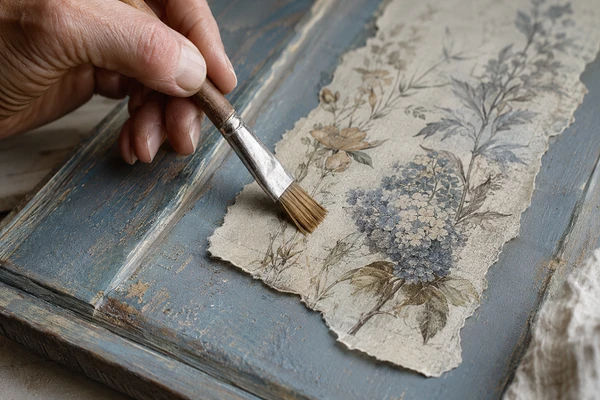
Good decoupage begins before adhesive reaches the surface. The maker can first place the dry paper over the project, study the scale, and decide which details should remain. Trimming produces a defined edge, while carefully torn edges can blend more softly into a layered background.
The surface should be clean, stable, and suited to the chosen medium. Working from one area toward another helps reduce trapped air and creases. Methods vary with the surface, adhesive, and finish, so test a small section first.
After the paper is secure and dry, surrounding paint or decorative effects can help integrate the image. A restrained glaze may soften a sharp transition. A coordinating border can frame the design. Gentle distressing around the wider surface can reinforce the aged mood without obscuring the printed art.
More Possibilities in Mixed Media Art
Mixed media invites the artist to combine paper with paint, texture, drawing, stamping, fabric, transfers, or dimensional details. Vintage-style imagery works well in this setting because it can act as either a focal point or a quiet background layer.
For example, an illustrated flower may sit over a painted panel with faint script beneath it. A nautical image can be paired with blue-gray color, weathered texture, and simple linear marks. Seasonal artwork can update a display box, sign, or decorative panel without requiring every element to follow the same pattern.
The goal is not to add as many materials as possible. Strong mixed media work usually depends on balance. Repeating one or two colors, leaving areas of visual rest, and varying the scale of images can make the composition feel intentional.
Careful Storage Protects Future Projects
Store unused sheets flat in a clean, dry place away from direct or intense light. The Library of Congress offers similar care guidance for works on paper, including stable conditions, minimal light, and supportive storage. Simple care helps prevent damage before the next project.
Give an Everyday Surface a Story
Vintage character does not have to come from an antique shop. With the right image, thoughtful placement, and a balanced finish, a modern craft surface can feel layered with memory and charm. Explore the full collection at Milton’s Daughter and choose a design that can give your next decoupage or mixed-media project its own distinctive story.

Comments are closed.